
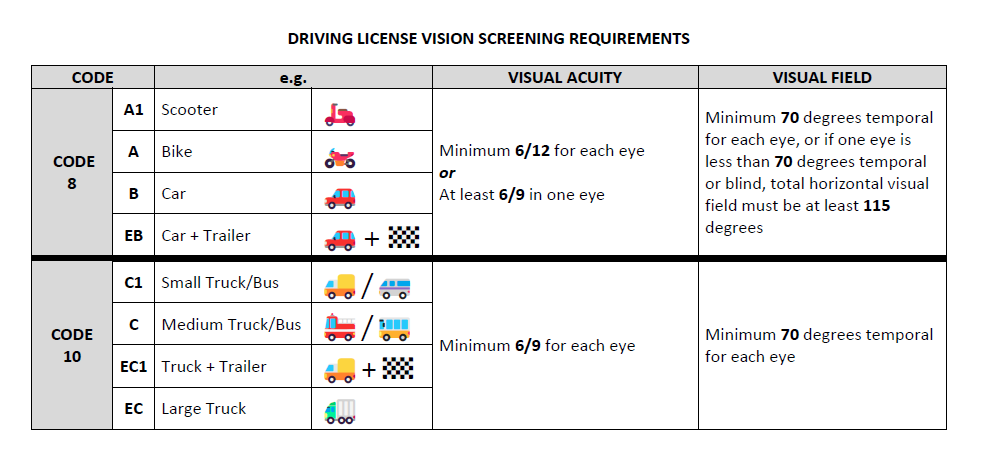
| Snellen (ft) | Snellen (m) | Decimal | LogMAR | Near Vision (approx.) |
|---|---|---|---|---|
| 20/10 | 6/3 | 2.0 | -0.1 | N4–N5 / J1 |
| 20/15 | 6/4.5 | 1.33 | -0.12 | N5 / J1–J2 |
| 20/20 | 6/6 | 1.0 | 0.0 | N6 / J2–J3 |
| 20/25 | 6/7.5 | 0.8 | 0.1 | N8 / J3–J4 |
| 20/30 | 6/9 | 0.67 | 0.18 | N10 / J5 |
| 20/40 | 6/12 | 0.5 | 0.3 | N12 / J6 |
| 20/50 | 6/15 | 0.4 | 0.4 | N14 / J7 |
| 20/100 | 6/30 | 0.2 | 0.7 | N24 / J10 |
| 20/200 | 6/60 | 0.1 | 1.0 | N36 / J12+ |
| Abbreviation | Latin Meaning | English Meaning |
|---|---|---|
| p.o. | per os | by mouth, orally |
| gtt(s) | gutta(e) | drop(s) |
| b.i.d. | bis in die | twice daily |
| t.i.d. | ter in die | three times a day |
| q.i.d. | quater in die | four times a day |
| prn | pro re nata | as needed |
| h.s. | hora somni | at bedtime |
| stat | statim | immediately |
| o.d. | oculus dexter | right eye |
| o.s. | oculus sinister | left eye |
| Category | Visual Acuity (Snellen) | % of Normal Vision* | Estimated Uncorrected Refractive Error (Diopters) |
|---|---|---|---|
| Normal | ≥ 6/12 (≈20/40) | 100% – 50% | Plano to ±0.50 D |
| Mild VI | <6/12 to ≥6/18 (20/40–20/60) | 50% – 33% | -0.75 to -1.50 D (myopia) +1.50 to +2.50 D (hyperopia) |
| Moderate VI | <6/18 to ≥6/60 (20/60–20/200) | 33% – 10% | -2.00 to -3.00 D (myopia) +3.00 to +5.00 D (hyperopia) |
| Severe VI | <6/60 to ≥3/60 (20/200–20/400) | 10% – 5% | -3.50 to -5.00 D (myopia) +5.50 to +8.00 D (hyperopia) |
| Blindness | <3/60 to ≥1/60 (CF at 1m) OR visual field <10° |
5% – 1% | -6.00 to -10.00 D (myopia) >+8.00 D (hyperopia) |
| Near Total Blindness | <1/60 to LP (Light Perception) | 1% – 0.1% | -10.00 to -15.00+ D (myopia) Hyperopia rarely causes LP |
| Total Blindness | No Light Perception (NLP) | 0% | Not caused by refractive error — structural/neurological damage |
*Note: "% of normal vision" is a simplified approximation for public understanding. It is based on relative Snellen acuity (20/20 = 100%, 20/40 = 50%, 20/200 = 10%, etc.), and is not a medical or functional vision score. Real-world function depends on contrast, field, color, lighting, and brain processing.